
Before you order your bottle labels, it’s essential to consider how you plan to apply them. Explaining your application process to your label manufacturer early on will ensure that your labels are supplied in the best possible format, saving on cost and application time in the long-run.
4 simple steps to successfully apply bottle labels by hand
For the purposes of this article, we will be sharing our advice on hand applying bottle labels that are either front and back labels or wrap-around labels.
A front and back label – a common way of labelling your bottle is with a front label for your brand, logo, and varietal, with a separate label for the back to give additional information, such as nutritional values, product history, brand story, and so on.
A wrap-around label for curved surfaces – another common format is to print on a single label that can then be wrapped around the bottle for a continuous design.
What you will need:
- Clean, dry bottles
- A clean, microfibre cloth
- Alcohol wipes (optional)
- Self-adhesive labels
Step 1: Get to Know Your Bottle
Bottles come in all shapes and sizes. While many look similar, it’s important to check the area where your bottle label will be applied. Does the bottle have a subtle lip, a sloping neck or a seam? These features can affect how well the label sits and are one of the most common causes of puckering, creasing, bubbles or wrinkles. As a general rule, the flatter the surface, the easier it is to achieve a professional finish.
Step 2: Make sure the bottle is clean
For the best results, the surface should be clean and free from dust, grease or residue before applying your self-adhesive labels. Alcohol wipes are a great way to prepare the bottle, but be sure to dry the surface afterwards with a lint-free microfibre cloth.
The ideal application conditions will depend on the label material and adhesive. While many labels are applied to clean, dry bottles, some materials are specially designed for chilled bottles or even bottles with light condensation. If you’re unsure which is right for your product, your label supplier can recommend the best label material and adhesive for the job.
Expert Tip: Whether you’re labelling wine bottle labels, beer, cider or soft drinks, choosing the right label material and adhesive is just as important as applying it correctly. The right specification will help your labels perform at their best.
Step 3: Align your labels
Once you’ve decided where the label will go, use the bottle’s seam as a guide to help keep it straight while applying. If the seam isn’t easy to see, a ruler, measuring tape and a light pencil mark can help you position your bottle labels accurately.
Step 4: Apply your labels
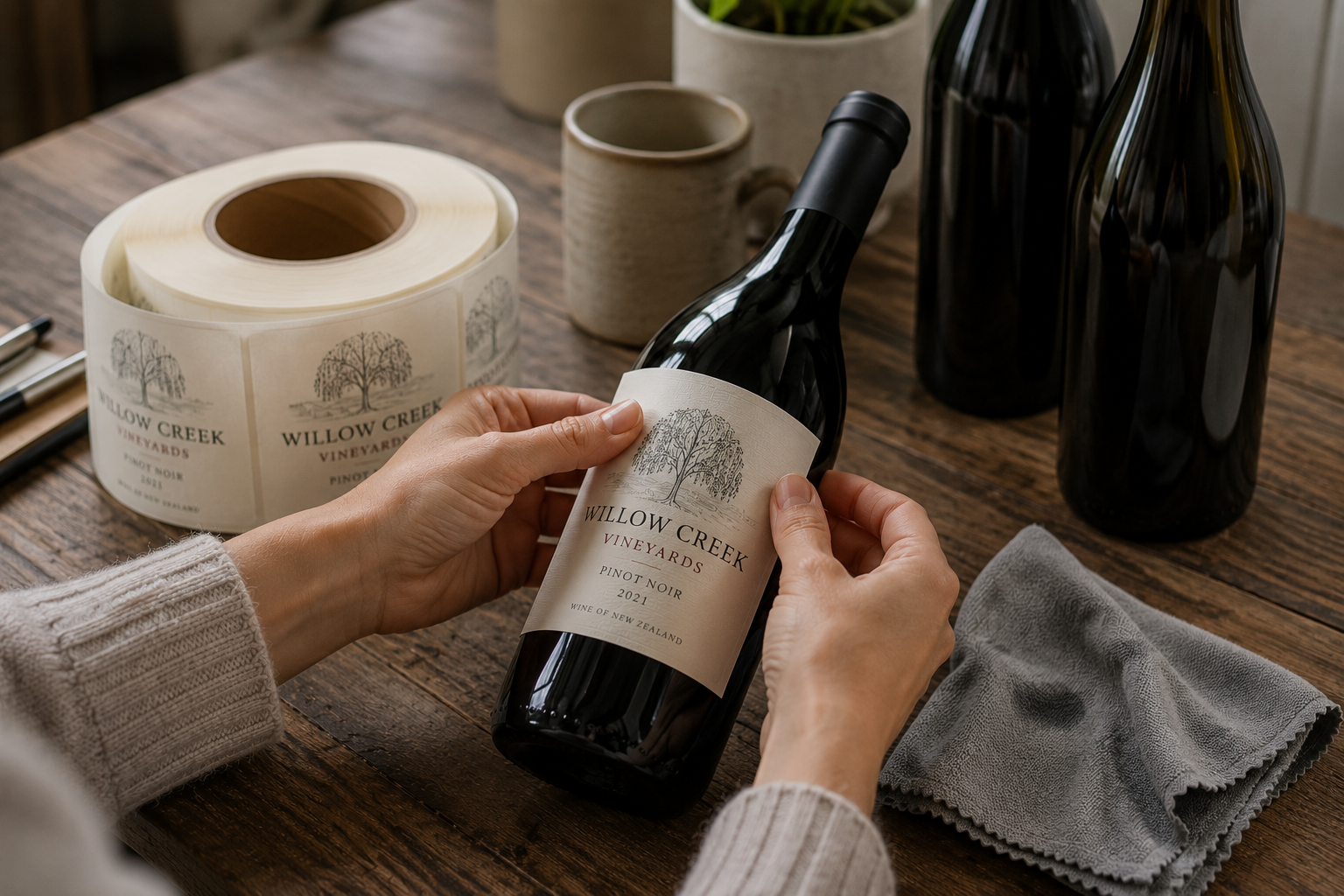
Remove the self-adhesive label from the backing by peeling it away from one corner. Hold the label by the edges to avoid transferring dirt, dust or natural oils from your fingers onto the adhesive. If you’re applying larger labels from a roll, peeling back only part of the label first and keeping the backing under slight tension can make application easier.
To stop the bottle rolling, hold it securely on your lap when applying front and back labels, or place it between two sturdy objects, such as blocks of wood.
Apply the label from one side to the other using steady pressure to minimise air bubbles and wrinkles. Once it’s in position, gently smooth it down with a clean microfibre cloth. Most labels will continue to bond after application, so allow around 12–24 hours for the adhesive to fully cure before handling or packing the bottles.
Time to scale?
Applying bottle labels by hand is a great solution for short-run, but this may not be sustainable when your production levels increase. As your business begins to grow, it might be time to consider options such as a manual bottle label applier, or a full-scale labelling service.
Let’s get your labels stuck on success.
Whether you require labels for a short run provided on sheets or a larger order supplied as labels on rolls, we’re here to help.
To discuss your next project, call the Label Solutions team on 01277 811 199, or request a quote using our simple online form.

Recent Comments