
If you’re ordering custom labels or custom stickers for the first time, you might already know what you want your labels to look like. From there, there are a few practical details that can help you get the right labels for your product, including materials, size, finish, quantity and artwork.
The good news? If you’re still deciding, we can help you work through your options.
At Label Solutions, we’ve been helping businesses with custom label printing for over 25 years, and many of our customers come to us without any prior experience of ordering labels.
In this guide, we’ll explain the key things to consider before ordering custom labels, so you can feel more confident when requesting and comparing quotes.
What are you using your labels for?
One of the most useful things to tell your label supplier is what your labels will be used for.
A luxury candle, food product, cosmetic bottle or cleaning product can each benefit from a different label specification. By understanding your product and how the label will be used, your label supplier can recommend suitable materials, adhesives and finishes.
Choosing the right label material
The right label material helps your labels look, feel and perform as you need them to.
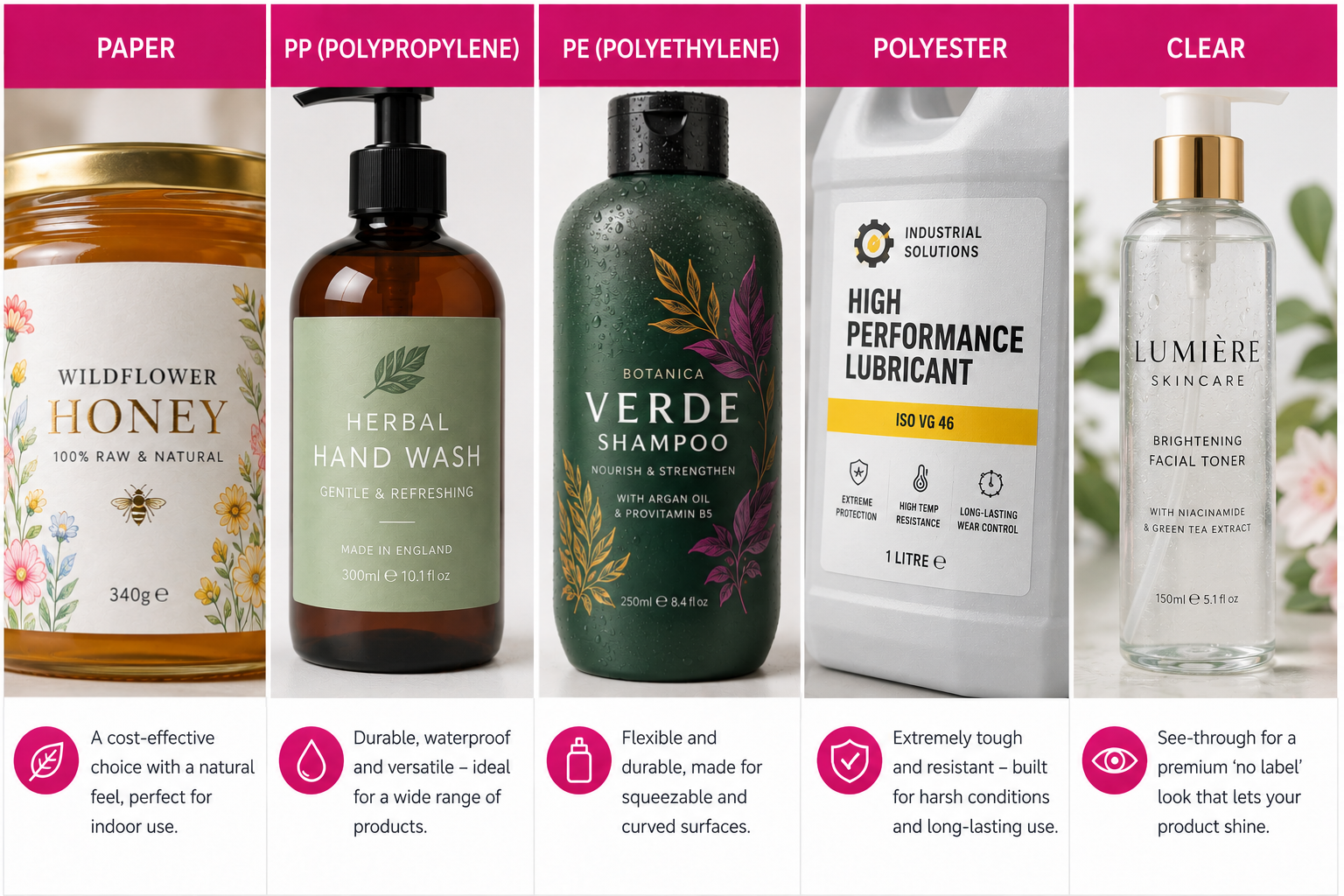
There are lots of options available, and your label printer can help you choose the one that works best for your product. Here are some of the common choices:
Paper labels
A popular and cost-effective choice for many retail products and food labels where the label won’t be exposed to moisture.
Polypropylene (PP)
A durable, waterproof material that’s ideal for drinks, health and beauty products, household goods and many other product labels.
Polyethylene (PE)
A flexible material designed for squeezable containers such as shampoos, lotions and cleaning products.
Polyester
An extremely durable option that’s often used for industrial labels and products exposed to tougher environments.
Clear labels
Clear labels can create a premium “no label” appearance, allowing the packaging itself to take centre stage.
The most suitable material will depend on your product, packaging and how the label needs to perform.
Making sure your labels stick
The adhesive keeps your label securely in place, making it an important part of the overall label specification.
Different products and environments call for different adhesives. A label that needs to cope with moisture, refrigeration or heat, for example, may need a different adhesive from one that’s going onto a product kept in normal indoor conditions.
Depending on your product and how the label will be used, options can include:
- Permanent adhesive
- Removable adhesive
- Freezer-grade adhesive
- High-tack adhesive
Just let us know where and how your labels will be used, and we’ll help you explore the most suitable options.
Add the right finishing touch
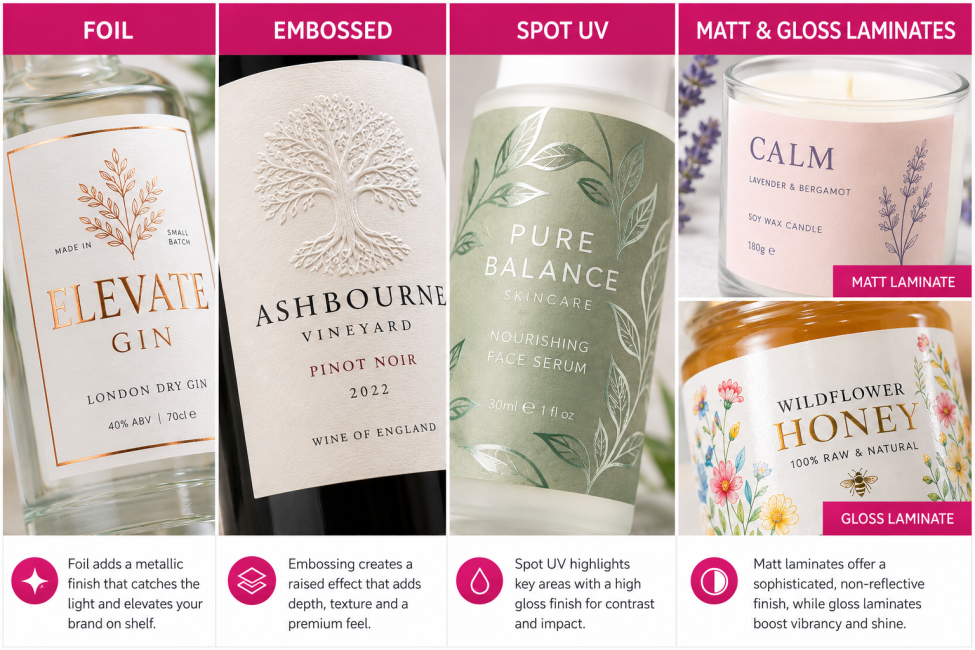
Your label finish can make a real difference to the final look and feel of your product. It can also enhance different elements of your design once printed.
Popular options include:
- Gloss finishes for vibrant colours and a brighter appearance.
- Matt finishes for a more understated, premium look.
- Foil finishes for a luxury or high-impact appearance.
- Embossing to add texture and a more tactile finish.
- Varnished effect for an all-over gloss to provide a colour pop, or a subtle and sophisticated matt finish.
- Protective lamination for additional protection against moisture, scratches, UV and fading.
If you’d like to explore different possibilities before choosing, our free label sample pack is a useful way to see and feel a range of different materials and finishes.
How will your labels be applied?
It’s helpful to think about how your labels will be applied when you’re getting a quote.
Will you apply them by hand, or will you use a labelling machine?
Hand application is common for smaller runs, while machine application is useful where speed and consistency are important. If you’re using a labelling machine, let your label supplier know when requesting a quote. The machinery and application process can influence the label specification and how your labels are supplied.
At Label Solutions, we’re happy to offer technical support, with a dedicated Technical Liaison Manager on hand to help make sure your labels are right for your application and labelling equipment if needed.
How Many Labels Do You Need?
Whether you’re ordering a few hundred labels or hundreds of thousands, the quantity can help determine the most suitable printing method and overall cost.
If you’re ordering labels for several products or have multiple SKUs, make sure you provide this information when requesting a quote. The number of designs and quantities required can influence how your job is produced.
We help our customers consider the most cost-effective solution for their requirements.
When comparing quotes, it’s worth looking beyond the price and checking that you’re comparing like-for-like. Different label materials, adhesives, finishes, print processes and quantities can all affect the cost, so the cheapest quote isn’t always the best value if you’re not getting the same specification.
Preparing Your Artwork
A little bit of preparation can make the printing process much smoother, so here are a few things to check before you send your artwork over:
Your artwork should ideally include:
- High-resolution images
- Correct dimensions
- Bleed where required
- Clear barcodes or QR codes, if applicable
- Fonts that are embedded or outlined
It’s worth checking that your artwork is the right size and quality for print. Low-resolution images, screenshots and AI-generated images can sometimes need a bit of work before they’re ready to print.
Not sure what file format to send? It’s worth checking with your printer first. You can also take a look at our artwork guidelines here for a few helpful tips.
A little label homework: useful details to have ready
Having a few details ready will help us give you a more accurate quote. It can help to have the following information ready:
- What the labels are for and how they’ll be used
- Label size and shape
- Quantity and number of designs
- How the labels will be applied
- Material and finish, if you know what you need
- When you need the labels
- Your artwork, if it’s ready
And if you’re still working through some of these details, that’s absolutely fine. Tell us what you do know and we’ll help you work through the rest.

Common Mistakes to Avoid
If you’re ordering custom labels for the first time, a few simple checks can help you get the best result for your product.
- Choosing based on price alone
Getting a competitive price is important, and comparing like-for-like specifications helps you understand the best value for your product. Lots of factors can all influence the overall cost, so looking at the full specification alongside the price gives you a clearer picture.
- Forgetting where your labels will be used
Thinking about your product’s environment helps you choose a label specification that’s designed to perform well in those conditions. Let your label supplier know how and where your labels will be used, and they can help you find a suitable solution.
- Using low-quality artwork
High-quality artwork helps you get the best from your printed labels. Checking your image resolution, dimensions and bleed before sending your artwork over gives your design the best possible start to look its best on the finished label.
- Forgetting how the labels will be applied
Whether your labels are being applied by hand or machine can influence the specification you need, so let your supplier know how the labels will be applied when requesting a quote.
Let’s Talk Labels
Let’s stick with the basics. Whether you need food labels, bottle labels, cosmetic labels or something completely unique, our friendly team can help you work through the options and recommend a suitable solution – without the jargon.
Get in touch with us today to discuss your next custom label printing project.

Recent Comments