
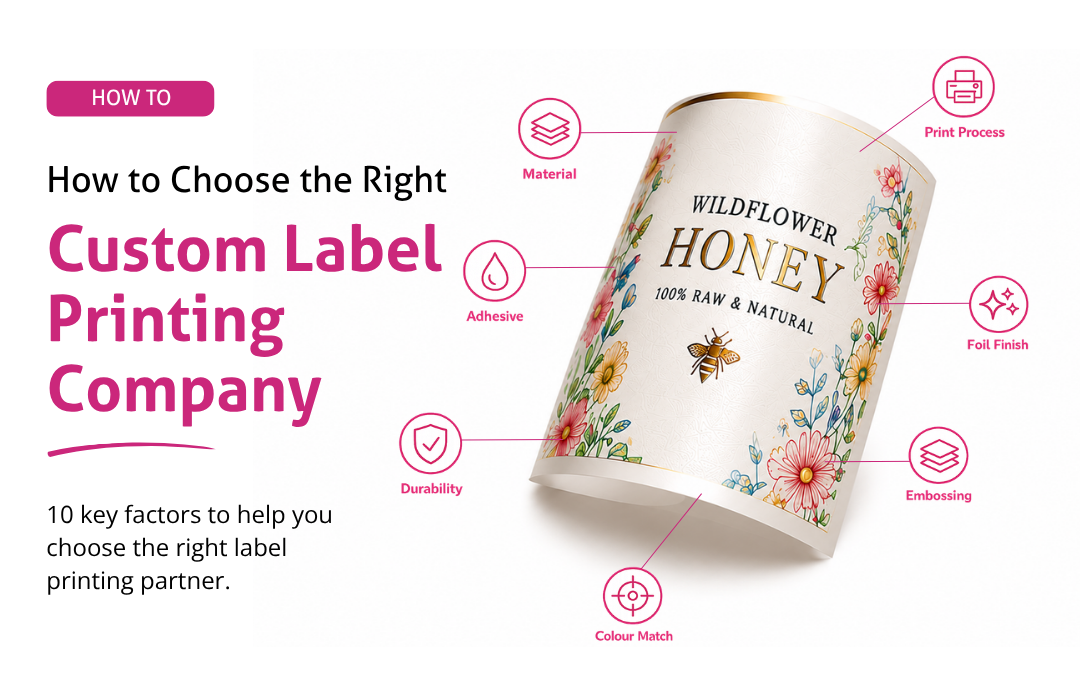
When you’re investing in labels, choosing the right custom label printing company is about more than finding the lowest quote. While price matters, the right supplier should save you time, solve problems before they happen and help your products look their best.
Whether you’re launching a new product, refreshing your packaging or looking for a more reliable supplier, your custom sticker printing partner should do more than just print labels. They should understand your industry, recommend the best materials and finishes, and make the whole process as straightforward as possible.
At Label Solutions, we’ve been helping businesses do exactly that for over 25 years. In this guide, we’ll share what to look for in a custom label printing company so you can choose a supplier that’s the right fit for your business.
Look for Experience in Your Industry
Not all labels are created equal. If only label printing came with a one-size-fits-all answer. The reality is that the “best” printing method depends entirely on what you’re trying to achieve.
A label designed for a luxury cosmetics brand has very different requirements from one intended for frozen food packaging, industrial equipment or bottled beverages. Choosing a label manufacturer with experience in your sector means they’ll already understand many of the challenges your product is likely to face.
For example:
- Food labels often need to withstand refrigeration, freezing or exposure to moisture while complying with food labelling regulations.
- Drinks labels may require premium finishes, excellent adhesion to glass bottles and resistance to condensation.
- Industrial labels often need to resist chemicals, abrasion, UV exposure or harsh outdoor environments.
- Health & beauty products frequently demand premium presentation alongside materials that perform well in bathrooms and humid environments.
An experienced supplier will advise you to prevent common problems such as labels peeling away, colours fading, adhesives failing or materials deteriorating before the product reaches the customer.
So it’s worth looking at the range of industries a company serves. A supplier that regularly works across multiple sectors has often encountered a wider variety of applications, allowing them to recommend solutions that may not be immediately obvious.
Choose a Label Printing Company That Can Recommend the Right Printing Process
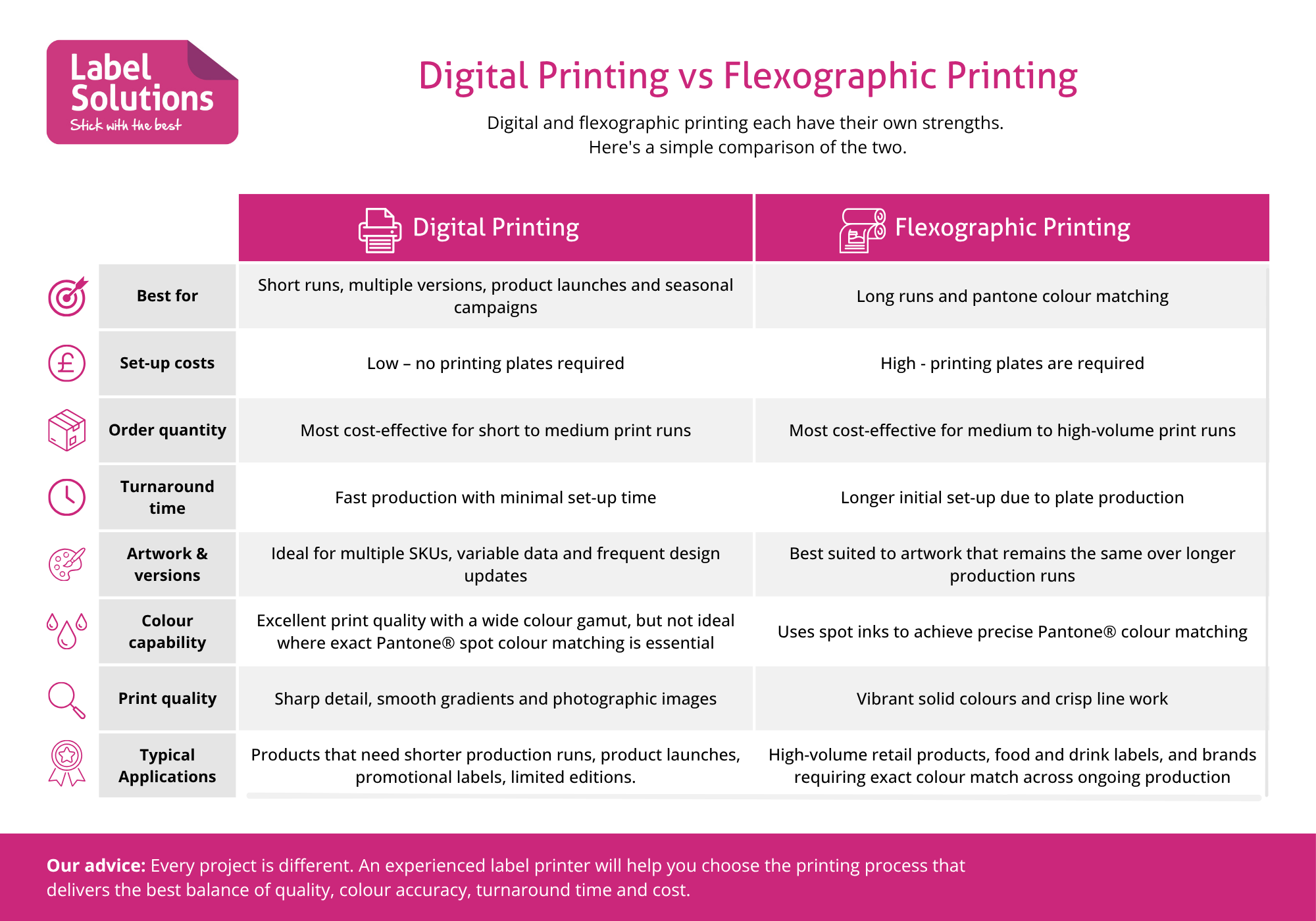
One of the biggest misconceptions is that there’s a single “best” printing method. In reality, each printing technology has its own strengths and limitations, and the right choice depends entirely on your product, budget, order quantity and desired finish.
A reputable custom label printing company should be able to recommend the most suitable printing process for your project rather than forcing every order through the same production method.
Digital Printing
Digital printing is ideal for shorter print runs, multiple product variations and designs that change regularly. It offers excellent print quality, quick turnaround times and avoids the cost of printing plates, making it particularly suitable for product launches, seasonal promotions and smaller production runs.
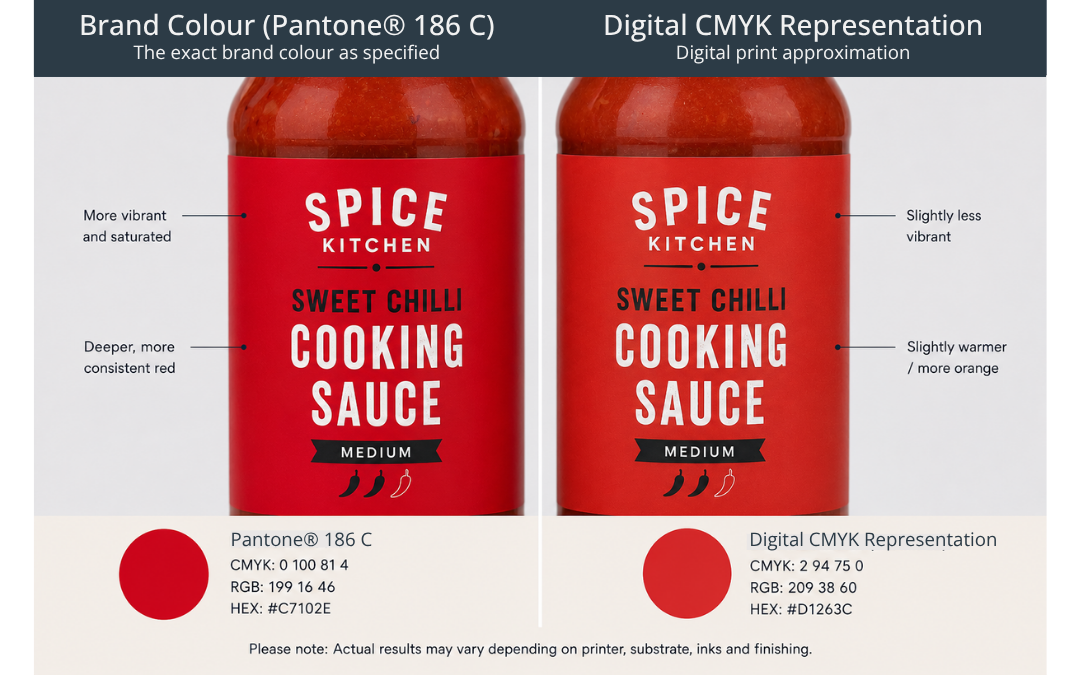
However, for very large orders, digital printing may not always be the most cost-effective option. It’s also worth considering colour requirements. Whilst digital presses produce excellent colour reproduction, they don’t use traditional spot inks, so if your branding relies on matching specific Pantone® colours exactly, another printing method such as flexographic printing may be more suitable. An experienced supplier will recommend the option that best balances colour accuracy, quality and budget.
Flexographic Printing
Flexographic printing is often the most economical choice for higher-volume orders. It delivers consistent quality over long production runs and can print onto a wide variety of materials, making it an excellent option for established products with ongoing demand.
Because flexographic printing uses custom printing plates and spot inks, it’s often the preferred choice for brands that require precise Pantone® colour matching. The trade-off is that the initial setup costs are higher, making it less economical for small quantities or designs that change frequently.
Rather than asking which printing process is “best”, ask which one is best for your needs. Factors such as order quantity, artwork, colour requirements, lead times and budget should all influence the decision. A knowledgeable label printing company will take the time to understand your requirements and recommend the most appropriate solution – not simply the one they use most often.
Check Their Material and Adhesive Knowledge
A beautiful label is only half the story. Good labels don’t just stick — they stick around. If it’s printed on the wrong material or paired with the wrong adhesive, it may not stay where it belongs for very long.
Choosing the correct label stock and adhesive is one of the most important decisions in the entire process, yet it’s often overlooked by businesses ordering labels for the first time.
A good label manufacturer should take the time to understand how your labels will be used before recommending label materials. Most experienced printers will be able to advise you as soon as they know what product you need labels for.
The product will determine which combination of material and adhesive will provide the best long-term performance.
For example, products stored in chilled environments may require specialist freezer adhesives to maintain reliable adhesion, while premium food and drinks brands often choose textured materials that enhance the overall look and feel of their packaging. Industrial applications may require highly durable synthetic materials capable of resisting chemicals, abrasion and weathering.
The finish is equally important. Matt laminates can create a sophisticated appearance, gloss finishes produce vibrant colours, while specialist materials and embellishments like foil finishes can help products command greater attention on the shelf. If you’re looking to create a premium look, there are a range of embellishment techniques that can transform your label.
An experienced supplier won’t simply present a catalogue of materials. They’ll explain why one option is more suitable than another, helping you invest in a solution that performs consistently throughout the product’s lifecycle. If you’re new to label printing, our beginner’s guide to custom product labels explains the basics of the different materials, adhesives and finishes available.
This level of technical advice is often what separates an experienced label manufacturer from a business that simply prints whatever artwork it’s given.
Consider the Finishing Options Available
A label doesn’t just identify a product – it’s often one of the first things a customer notices. The right finishing options can transform a standard label into one that communicates quality, reinforces your brand and helps your product stand out in a competitive market.
If presentation is important to your business, it’s worth choosing a custom label printing company that offers a wide range of embellishments and finishing techniques rather than a one-size-fits-all solution.
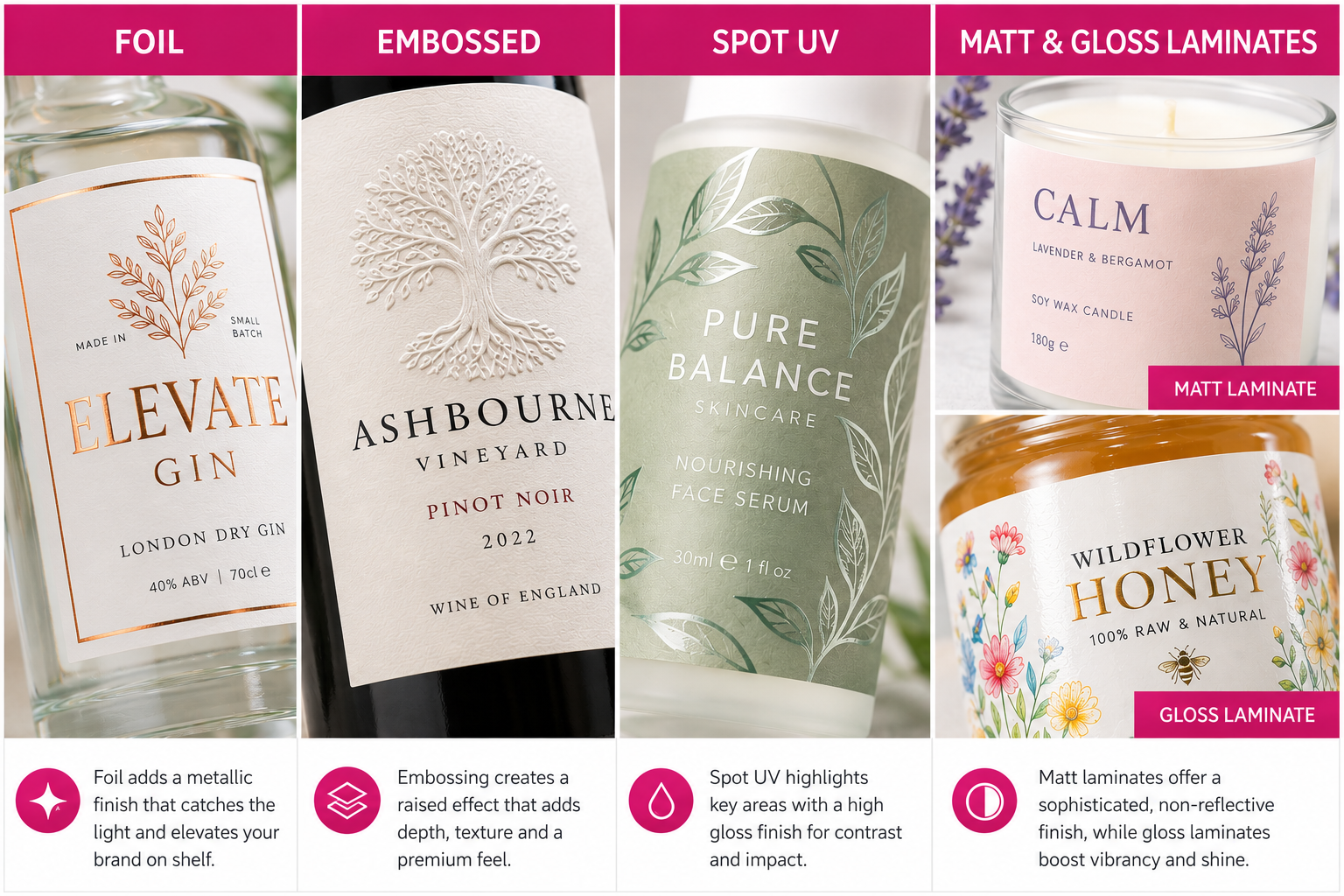
Some of the most popular finishing options include:
Foil Blocking
Foil label finishes use metallic or coloured foils to highlight key design elements such as logos, product names or decorative details. Gold, silver and copper remain popular choices, but many other colours are available to suit different branding styles.
Foiling is particularly effective for premium food, drinks and health & beauty products where shelf appeal plays an important role in purchasing decisions.
Embossing and Debossing
Embossed labels is one of the best ways to add a touch of luxury to your labels. Embossing raises selected areas of the label to create texture and depth, while debossing presses the design into the material.
These tactile finishes add another dimension to packaging, helping products feel as premium as they look.
Spot UV Varnish
Spot UV can apply a high-gloss coating to selected areas while leaving the rest of the label matt or vice-versa – add a matt coating on a high-gloss label.
The contrast between finishes creates a subtle visual impact and is an excellent way of drawing attention to logos or product names without overwhelming the design.
Matt and Gloss Laminates
Protective laminates improve both durability and appearance.
A matt laminate creates a sophisticated, understated finish that’s popular for luxury brands, while gloss laminate enhances colour vibrancy and provides additional protection against moisture and scuffing.
The right finish depends on your product, your brand and the impression you want customers to have. A knowledgeable supplier should be able to recommend the most appropriate options rather than simply offering every available embellishment.
Choose a Label Supplier That Can Support You with Artwork
Even the best printing equipment can’t compensate for artwork that hasn’t been prepared correctly.
Poorly supplied artwork is one of the most common causes of production delays, unexpected costs and disappointing print quality. That’s why it’s worth choosing a custom label printing company that provides artwork guidance as part of its service.
A knowledgeable supplier should be able to advise on:
- Bleed requirements
- Safe zones
- Die lines and cutter guides
- Image resolution
- Colour consistency
- Pantone colour matching
- Font and file compatibility
- Proof approval before production
Many businesses don’t have an in-house designer or packaging specialist, and that’s perfectly normal. Whether you’re creating your first product label or updating an existing design, having access to technical advice can prevent small issues becoming expensive mistakes.
For example, artwork positioned too close to the edge of a label may be trimmed during production, while low-resolution images can appear blurred or pixelated once printed. Colour differences between digital screens and printed labels can also lead to unexpected results if appropriate colour management isn’t considered.
A good supplier won’t simply reject artwork that isn’t production-ready. They’ll explain what needs adjusting and work with you to achieve the best possible outcome.
This collaborative approach not only improves print quality but can also reduce delays and minimise the need for costly reprints.
Reliability Matters Just as Much as Print Quality
Producing high-quality labels is only part of the job.
For many businesses, reliable deliveries and consistent service are equally important. A late delivery can delay production schedules, prevent products from being dispatched or even leave shelves empty while businesses wait for replacement stock.
When comparing label printing companies, ask how they support customers beyond the printing process.
Some useful questions include:
- What are your typical lead times?
- Can you accommodate urgent orders?
- Do you offer scheduled deliveries?
- Can you hold stock for repeat orders?
- Will I have a dedicated point of contact?
- How do you ensure colour consistency across repeat print runs?
These practical considerations can have a significant impact on your day-to-day operations, particularly if you’re ordering labels regularly or managing multiple product lines.
Consistency is another important factor that’s often overlooked.
Customers expect the same colours, finishes and print quality every time they purchase your product. A reliable label manufacturer should have robust quality control procedures in place to ensure repeat orders match previous production runs as closely as possible.
Communication also plays an important role.
If specifications need to change, deadlines move or artwork requires amendments, working with a responsive supplier who keeps you informed throughout the process can make projects run far more smoothly.
Ultimately, the best supplier isn’t necessarily the one who promises the fastest turnaround on a single order – it’s the one who consistently delivers quality, reliability and support over the long term.
Understand the Difference Between Price and Value
We’ve all heard the saying “buy cheap, buy twice.” Labels can be no different. Saving a little upfront can sometimes cost considerably more if materials fail or reprints become necessary.
A lower price may reflect compromises elsewhere, whether that’s in the quality of materials, colour consistency, finishing options or customer support. While these differences might not be obvious initially, they can become expensive if labels fail during application, peel away in storage or don’t present your product as intended.
On the other hand, investing in high-quality custom label printing can help you avoid unnecessary waste, reduce production issues and create a better first impression for your customers.
When evaluating suppliers, consider the overall value they provide, including:
- Print quality and consistency
- Material and adhesive recommendations
- Technical advice
- Proofing and artwork support
- Reliable lead times
- Responsive customer service
- Quality control
- Long-term partnership
The best label printing company should help your business save time, reduce risk and deliver consistently high-quality packaging—not simply offer the lowest quote.
Do You Need Custom Labels or Custom Stickers?
Many people use the terms labels and stickers interchangeably, and in many cases they’re produced using similar printing processes. However, understanding the difference can help you choose the most appropriate solution for your application.
Generally speaking, custom labels are designed for products, packaging and operational purposes. They often need to withstand demanding environments, comply with industry regulations or perform reliably throughout a product’s lifecycle.
Custom stickers, meanwhile, are commonly used for promotions, branding, giveaways, window graphics and decorative applications, although they can also be used on products depending on the intended use.
The good news is that an experienced supplier should be able to produce both and recommend the most suitable material, adhesive and finish based on your requirements.
Whether you’re ordering product labels for retail packaging or custom sticker printing for marketing campaigns, the same principles apply: choosing the right materials, printing method and finishing options will ensure the final product performs exactly as intended.
Questions to Ask Before Choosing a Custom Label Printing Company
Before committing to a supplier, it’s worth asking a few key questions. Their answers will quickly give you an indication of their experience, technical knowledge and willingness to support your project.
Consider asking:
- Have you produced labels for products similar to mine?
- Which printing process would you recommend, and why?
- What materials and adhesives are most suitable for my application?
- Can you advise on premium finishes?
- Do you offer artwork support and pre-production proofs?
- What are your typical lead times?
- Can you accommodate urgent orders if required?
- Do you offer stock holding or scheduled deliveries?
- Who will be my main point of contact throughout the project?
A supplier that takes the time to answer these questions clearly and confidently is far more likely to become a reliable partner than one that focuses solely on providing a quotation.
Choose a Company That Wants to Build a Relationship
The best custom label printing company isn’t simply the one that manufactures your labels.
It’s the one that takes the time to understand your products, your business and your long-term goals.
As your business grows, your packaging requirements may evolve too. You might introduce new product ranges, move into different markets, refresh your branding or explore premium finishes that help your products stand out. Working with a supplier who already understands your business makes those transitions much smoother.
A long-term partnership also means you’ll have access to ongoing advice whenever you need It — whether that’s choosing a more sustainable material, improving durability, reducing costs or finding a better solution for a new application.
At Label Solutions, we’ve spent more than 25 years supporting businesses of all sizes, from start-ups launching their first product to established manufacturers managing extensive product ranges. That’s why we see ourselves as more than a label manufacturer. We aim to be a trusted partner that helps businesses create labels that perform in the real world and strengthen their brand.
Ready to put your best label forward?
Whether you’ve got a finished design or you’re still weighing up your options, we’re here to help. Get in touch with our team and we’ll help you find the right solution — without the jargon.
Recent Comments